
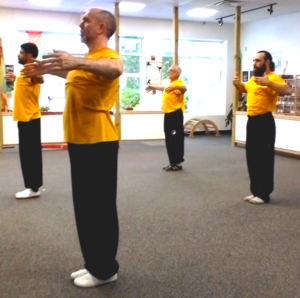
Yi Jin Jing (Tendon Transforming Classic), is a very famous qigong form that has been practiced for centuries in China. It has survived all this time because there are many good reasons to practice it. Besides improving mental focus and clarity, it will restore healthy circulation, harmonize emotions, and increase flexibility.
 Yi (易) means to change or transform.
Jin (筋) means tendons. However, the deeper meaning of Jin encompasses far more than tendons and sinews. In the context of Yi Jin Jing, it describes the entire human structure which includes the fascia network, skeletal system (including bone marrow) and muscular system.
Jing (經) translates to classic.
Another important yet often overlooked reason to practice Yi Jin Jing is the benefits it will have on the connective tissue. As we age, our fascia lose elasticity making us prone to injury, aches and joint pains. Regular Yi Jin Jing practice will condition the body externally by increasing flexibility, mobility and strength as well as internally by nourishing the fascia, muscles, sinews, ligaments and bones. Restoring and maintaining the elasticity of our fascia is crucial to mental/physical health and staying active.
According to Miriam Webster, elasticity is “the quality or state of being elastic: such as a : the capability of a strained body to recover its size and shape after deformation : springiness b : resilience”.
I love the definition of elasticity found in the science section of Britannica.com: “ability of a deformed material body to return to its original shape and size when the forces causing the deformation are removed. A body with this ability is said to behave (or respond) elastically”.
Yi Jin Jing transforms the body from the inside to outside utilizing deep breathing combined with stretches and intentional postures.