
Guest post by Shifu Guolin, 34th generation Shaolin Temple disciple, teaching qigong and Shaolin Kungfu. For more information about Shifu and opportunities to train with him, please visit his website at shaolinoverseas.com.
“There are principles of Tai Chi found everywhere, whether we recognize it or not”
~ Shifu Guolin
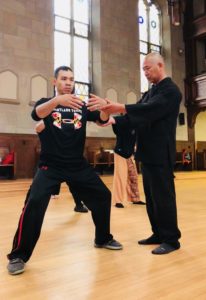
Chinese Wushu is profound and vast with a variety of styles. Generally speaking, we can categorize Wushu into northern and southern styles. In addition, there are differences between internal and external practice. Although there are various types of pugilistic methods which have particular style characteristics, their theoretical basis have roots in Chinese culture. Of course, Shaolin Kung fu also follows the same line without exception. That is to say, regardless of any types of pugilistic methods, they are all inseparable from the principle of TaiChi”. That is why there is a saying that “All fists (styles) return to Tai Chi.” The word “return” refers to the principle of returning to Tai Chi theory rather than the Tai Chi fist (as a martial art style) method.
Man did not create the principle of Tai Chi, nor is it unique to any kind of fist (martial art style) method. It is naturally inherited in the universe. Tai Chi lies in any sport and even in every aspect of life. We can find the principles of Tai Chi everywhere, whether we recognize it or not. As the “Book of Changes (I-Ching)” states, “people use it daily without knowing it.” Nowadays, martial arts practitioners commonly quote this statement . However, the practitioners may not realize that they are using it in daily practice.
During routine practice, many martial art practitioners may not feel satisfied with their practice due to lack of feeling the right moves. Their martial art movements are either too soft, too rigid or indistinct. Although practicing martial arts all year round, they are not able to go deep into the essence of the martial art that they are practicing. Therefore, they experience greatly reduced function of their martial arts. A lack of correct understanding of the principle of “Tai Chi” causes this phenomena.
If you want to truly understand Chinese Wushu, you need to first understand the principle of “Tai Chi.” In this way, a practitioner can really master the correct exercise method and train properly.
中国武术博大精深,种类繁多。总体来说有南北之分内外之别,虽然各类拳种在风格特点上有所区别,但是在理论基础上,都是植根于中国传统文化。当然少林寺功夫也不例外,都是一脉相承。也就是说不管是什么风格特色的武术运动都离不开“太极“这个理。所以有“万拳归太极“之说。这里所说归太极的“归“字,是归太极之理,并非归太极拳这个拳种。因为太极之理不是任何人创造的,也不属于任何一个拳种独有的,它本来就是自然存在的。也可以说在任何运动运动中乃至在生活中的方方面面,到处都存在着太极之理。只是我们是否能够认识而已,也正如“易经“中所讲,“百姓日用而不知“。这句话用在当今广大习武者身上也是如此,日用(练)而不知,所以造成很多练武者在练武的过程中,不是形不达意,就是偏刚偏柔,或者是虚实不分,虽然常年练习武术,但是最终还是不能深入其境,而武术本应有的功能也大大的降低了。这些现象的产生都是源于对“太极之理“没有或者缺乏正确的认识而造成的。所以说如果想要真正了解中国武术,只有在练习中认认真真去认识“太极之理“,才能掌握中国传统武术的正确锻炼方法。